E-commerce that adds up,because it reconciles
Ontology as the foundation: data scattered across systems converges into one set of business and finance semantics everyone agrees on.
Key pain points
In e-commerce, computing isn't the hard part —
reconciling is
Platform, ERP, finance, ads, logistics and payments each keep their own numbers; business and finance settle to different books that all land in one spreadsheet.
Many systems, many versions of the data
Marketplace, ERP, finance and payment systems each do their own thing; multiple shops, platforms and currencies are hard to merge.
Business and finance keep separate books
GMV, revenue, cost and profit measured three ways — reports fight as soon as they meet, and leadership never sees one book.
Platform, payment, ERP — matched by hand
Bills, flows and vouchers matched in Excel; locating a difference is slow and nobody is on the hook.
SKU-level net margin can't be computed
Channels, campaigns and influencer commissions stack up; no one knows which products truly make money — pruning is guesswork.
Incentive rules get impossible to recompute
Tiered, margin-based and team models pile up; rule versions aren't traceable and payslips never align with vouchers.
No global view of oversell, stock and compliance
Inventory isn't visible across channels, so payouts and bad reviews grow; revenue, invoice and tax chains are hard to trace.
Business view
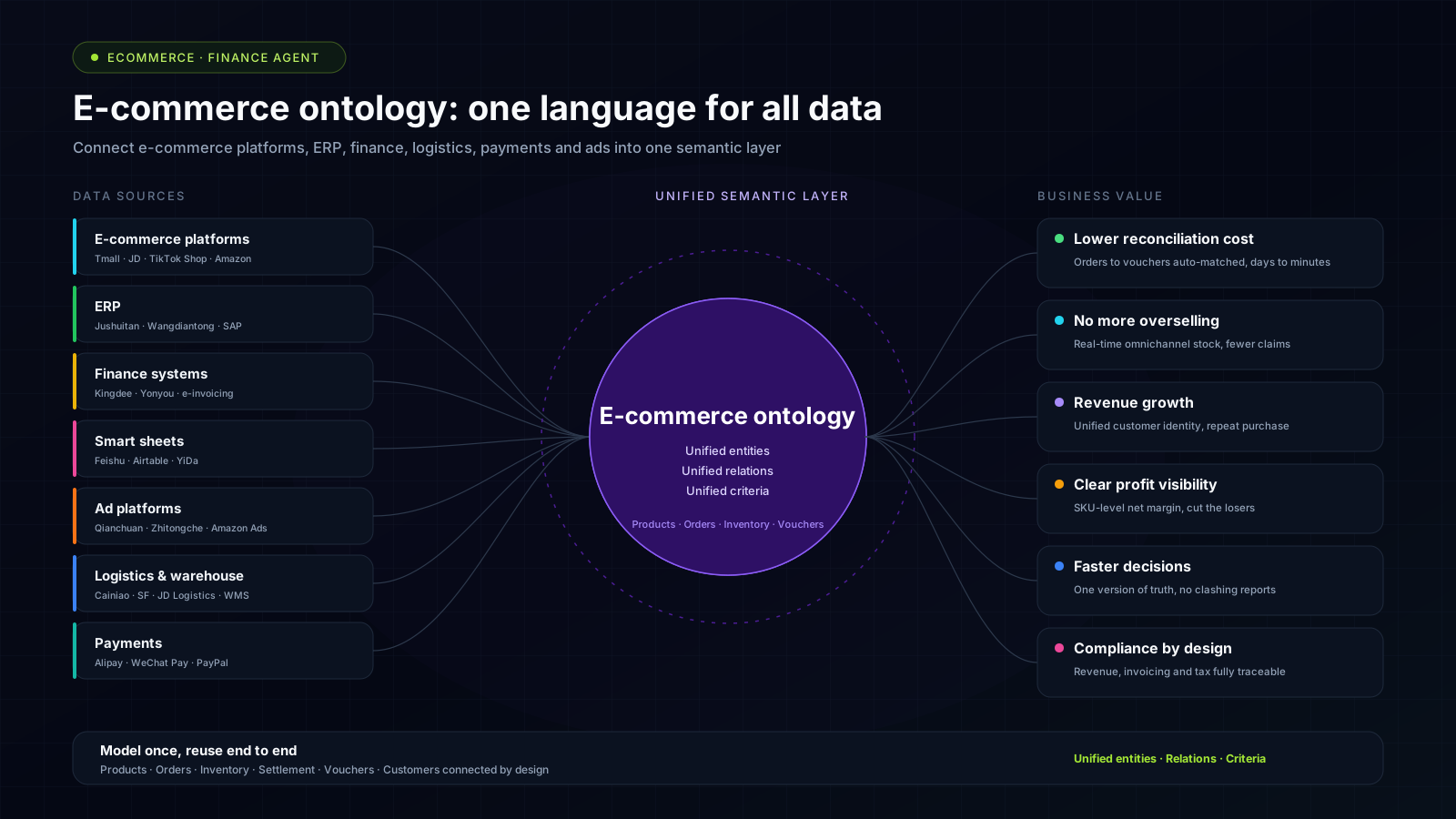
Model once, reuse across the whole chain
Many data sources connect into one set of entities, relationships and criteria — products, orders, inventory, settlement, vouchers and customers connect naturally.
How it works
Bring your bills and rules — reconcile one channel first
No need to onboard every system at once: align criteria on one platform and one shop first, then replicate across all channels.
Connect data
Platform bills, ERP orders, finance vouchers and payment flows connect into one semantic layer.
Unify criteria
Define GMV, revenue, cost and profit in the ontology the way both business and finance accept.
Match to vouchers
Differences traced to order and voucher level; SKU-level net margin and commissions can be recomputed, conclusions replayable.
Data preparation checklist
At the pilot kickoff, we'll confirm this list with you item by item.
- e.g. export of the last three months of platform bills (Tmall / JD / Douyin / Amazon)
- ERP orders and inventory data (Jushuituan / Wangdiantong / SAP)
- Finance vouchers or account balances (Kingdee / UFIDA)
- The current commission and incentive rule versions
FAQ
Quick notes on data, criteria and pilots
Which data do we need to connect?+
Platform bills (Tmall, JD, Douyin, Amazon, etc.), ERP (Jushuitan, Wangdiantong, SAP), finance systems (Kingdee, UFIDA), plus payment, advertising and logistics data — all connected into one semantic layer.
What if business and finance use different criteria?+
Define GMV, revenue, cost and profit in the ontology as criteria both sides accept; orders, settlement and vouchers match into one book — reports stop fighting.
How deep can reconciliation differences be traced?+
Down to order and voucher level, attributable by channel, shop, product and campaign — no more manual Excel ticking; SKU-level net margin and commissions are recomputable.
How do we start the first pilot?+
Bring your platform bills, ERP data and commission rules; together we confirm acceptance criteria for the first reconciliation or profit-analysis scenario.
Give business, finance and management one shared book
Bring your platform bills, ERP data and commission rules, and we confirm acceptance criteria for the first reconciliation or profit-analysis scenario together.