Every slow-moving line item,able to explain itself
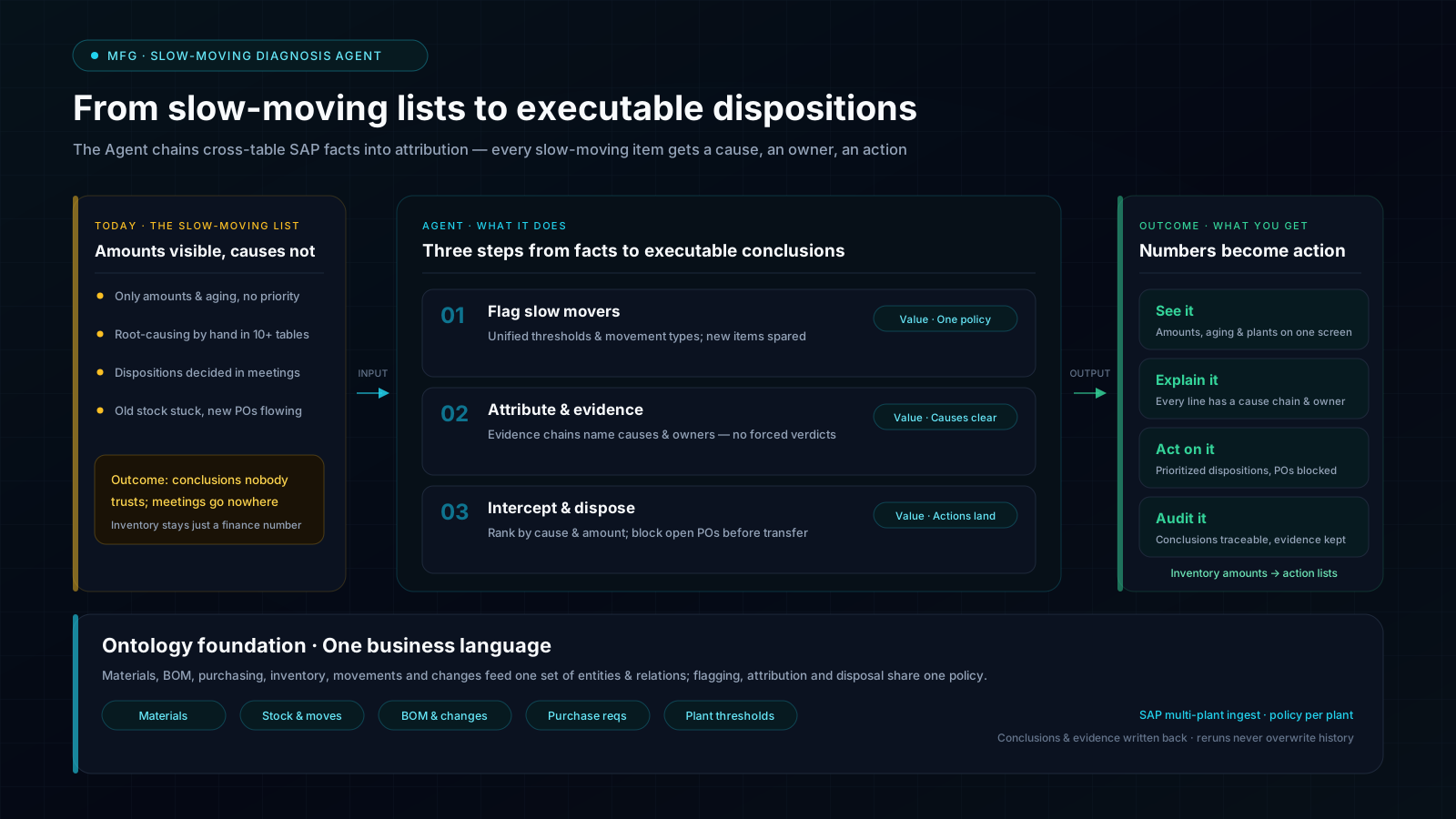
Chain cross-table SAP facts into attribution links, turning inventory amounts into traceable conclusions and executable dispositions.
Key pain points
In slow-moving analysis, the hard part isn't the amount —
it's explaining the cause
The moment any one of criteria, evidence, adjudication or disposition still depends on a person, results can't land on owners or actions.
One material, two conclusions from two plants
Each plant uses different 90 / 180 / 365-day thresholds, and stock-status or movement-type criteria don't match, so totals can't be compared across plants.
Sales cancels, demand decline and BOM obsolescence entangle
One conclusion takes manually combing a dozen SAP tables for evidence; change the analyst, change the story — and no department can confirm accountability.
No movement yet, instantly judged "dead"
New materials and pilot parts are judged slow-moving before any movement record exists; the business won't sign off and the diagnosis loses credibility.
Re-run once, and last round's results are gone
Attribution results and factual data are mixed together; re-runs overwrite history, so audits have no evidence chain to produce.
Money spread flat, order of attack decided by gut
Slow-moving lists carry only amounts and aging — no root cause, no owner, no executable action; disposition meetings turn into blame-shifting.
Clearing inventory while still ordering
Old stock is not yet consumed while open purchase requisitions keep converting to POs; disposition is disconnected from prevention, so slow-moving recurs.
Business view
What this Agent brings to inventory governance
Not yet another slow-moving report — every slow-moving line becomes a disposition chain with a cause, an owner, an action and full traceability.
Clarity
Slow-moving amounts, aging and plant distribution on one screen, comparable across plants on one set of criteria.
Explainability
Every slow-moving line carries an attribution chain, evidence and an owner — judgments no longer rest on anyone’s gut.
Actionability
Disposition lists ranked by root cause and amount; open purchases intercepted before conversion.
Traceability
Conclusions and evidence can be replayed; re-runs never overwrite history, so audits always have proof.
How it works
One plant, one material category — close one loop first
The first scenario aims to be complete, not comprehensive: close adjudication, attribution and disposition, then replicate criteria and evidence chains plant by plant.
Connect data
Bring in SAP material master, stock and movements, BOM changes and open purchase requisitions — read-only access, no changes to your systems.
Configure criteria
Configure slow-moving thresholds and movement-type criteria per plant, with new-part protection built in, so results are comparable across plants.
Close the loop
The Agent outputs adjudication, attribution and disposition lists; evidence is written back to the platform — re-runs never overwrite history, and audits can replay it.
Data preparation checklist
At the pilot kickoff, we'll confirm this list with you item by item.
- SAP table access for the pilot plant: materials, stock & movements, BOM, open purchase requisitions
- One set of materials to diagnose (e.g. one production line)
- One historical inventory snapshot for backtesting
- Current per-plant slow-moving thresholds and criteria (a spreadsheet is fine)
FAQ
Quick notes on data, criteria and pilots
Which data do we need to connect?+
A first plant scenario usually starts with SAP material master data, stock and movements, BOM and its changes, and open purchase requisitions. Per-plant thresholds and movement-type criteria are configured on the platform — no changes to SAP required.
What if each plant uses different criteria?+
The 90 / 180 / 365-day thresholds and movement-type criteria are configured per plant, while adjudication, attribution and disposition run on the same set of criteria — results are directly comparable across plants.
How are conclusions kept trustworthy?+
Every slow-moving line carries an attribution chain and evidence; conclusions are never forced when evidence is short. New parts without movement records are never outright judged slow-moving. Conclusions and evidence are written back to the platform, re-runs never overwrite history, and audits can replay everything.
How do we start the first pilot?+
Bring one plant, one set of materials and one historical inventory snapshot; together we confirm adjudication criteria, attribution hypotheses and acceptance criteria for the first workbench.
Turn slow-moving stock from a finance number into an executable disposition chain
Bring one plant, one set of materials and one historical snapshot — we confirm adjudication criteria, attribution assumptions and acceptance criteria for the first workbench together.